Truck insurance provides the necessary protection to both commercial drivers and trucking businesses against liability, damage, or loss of cargo.
In the United States, more than 3.5 million truck drivers drive for over 711,000 trucking companies, and more than 500,000 truck-related crashes occur annually. That high risk makes proper insurance critical.
Truck insurance is a necessary coverage for commercial drivers and trucking businesses, protecting against liability, damage, and losses of shipments.
Over 3.5 million truck drivers are working for more than 711,000 trucking firms in the United States, with more than 500,000 truck-related crashes every year. That high risk makes proper insurance critical.
What Is Truck Insurance?
Truck insurance refers to a kind of commercial vehicle insurance designed for big rigs, semi-trailers, and delivery trucks. It is different from the normal auto insurance since it considers higher risks and regulations related to hauling cargo.
Commercial trucking insurance policies explicitly cover the unique liabilities in the trucking industry. A key part is liability coverage: truck liability insurance protects against costs if your truck causes injury or property damage, covering medical bills, legal fees, and property repairs. Most truck policies are required to include this by law.
Additionally, you’ll typically add comprehensive and collision coverage for your truck itself-covering things like theft, fire, and accident damage-and motor truck cargo insurance or cargo protection for the goods you haul. For instance, cargo insurance reimburses shippers when goods are lost or damaged in transit.
Some carriers also include uninsured underinsured motorist coverage, bobtail non-trucking liability when the vehicle is unhitched, or occupational accident benefits. Essentially, trucking insurance bundles many protections in one policy, tailored to heavy vehicles and freight operations.
Types of Truck Insurance Coverage

A full-featured truck insurance policy can include multiple coverages to meet federal and state requirements:
-
Liability Coverage: Covers bodily injury and property damage to others if you’re at fault. For trucks, this often comes as a combined single limit (CSL). As one insurer explains, truck liability “includes bodily injury coverage (injuries to others) and property damage coverage (damage to others’ property FMCSA mandates high minimums (often $750K–$1M CSL) for interstate cargo haulers.
-
Physical Damage Coverage: This includes collision (repair for your truck after an accident) and comprehensive (non-collision losses like fire, theft, vandalism). For heavy trucks, a single accident can cost tens of thousands in repairs.
-
Cargo Insurance (Cargo Protection): Protects the value of your freight. Cargo protection kicks in if goods are lost, stolen, or damaged during transit. Certain freight (hazardous, perishable) may require higher limits.
-
Trailer and Interchange Insurance: If you haul or lease trailers that are not owned, interchange insurance covers physical damage to those trailers.
-
Uninsured/Underinsured Motorist: Covers you if another driver (with insufficient or no insurance) causes a crash.
-
MedPay/Medical Payments: Pays medical costs for you or passengers in your truck.
-
Specialized Endorsements: Such as non-trucking liability (for when the truck is driven off-duty without a trailer), occupational accident insurance (for driver injuries), and equipment breakdown.
Truck insurance can be customized by business needs. For fleets (multiple vehicles), insurers offer fleet truck insurance, packaging several trucks under one policy. Most companies require at least two vehicles to qualify as a “fleet. Fleet plans simplify management and may yield discounts per truck.
For owner-operators or small fleets, some providers (like OOIDA or CoverWallet) specialize in policies with flexible vehicle counts. In all cases, you’ll select coverages based on cargo type, driving radius, truck value, and personal risk tolerance.
Factors to Consider When Choosing Truck Insurance
When shopping for truck insurance, consider:
-
Coverage Needs: Determine what you must cover. Heavy rigs typically need high liability limits, comprehensive, collision, and cargo insurance. Federal contracts may demand extra coverages (like trailer interchange or larger CSL.
-
Carrier Financial Strength: Look for insurers rated “A” (AM Best) or similar. For example, many top providers (Progressive, Chubb) hold A+ ratings. Strong finances mean they can pay claims reliably.
-
Discounts & Programs: Some insurers offer safety discounts (e.g., based on electronic logging device data) or programs for safe drivers. Progressive’s Smart Haul program rewards good ELD records.
-
Customer Service & Claims: Fast, fair claims handling is critical. State Farm, for example, is noted for top customer service and an extensive agent network.
-
Cost/Pricing: Premiums vary widely by truck type, driving history, miles, and cargo. As Progressive data shows, the average monthly premium in 2024 ranged from about $746 for specialty truckers to $954 for general freight haulers. Remember, that’s an average – your rate depends on factors like experience and route.
-
Online Tools & Accessibility: Some insurers (Nationwide, Progressive) allow online quotes and mobile claims. Others (Farmers, State Farm) still rely on local agents. Decide what mix of digital access and personal service you want.
In summary, match the insurance to your operation: whether you run a large heavy-duty fleet or an owner-operator with a single semi, look at coverages, limits, price, and service. The following sections highlight 10 leading truck insurance options.
Top 10 Truck Insurance Companies in the USA
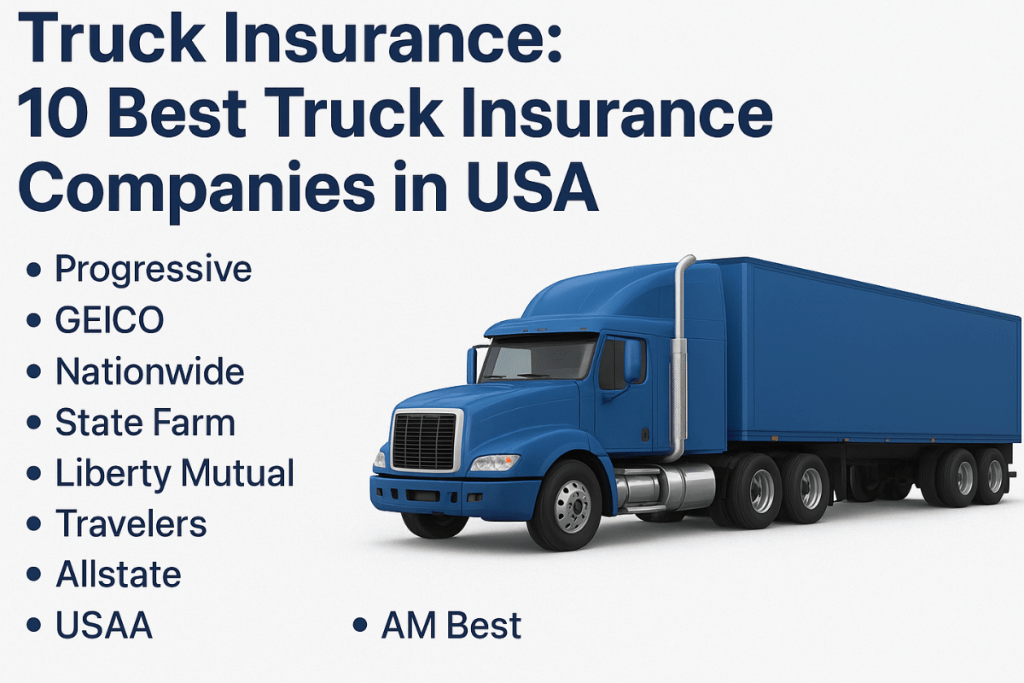
Below are the top 10 truck insurance providers, chosen for their strong coverage options, financial stability, and industry reputation:
-
Progressive Truck Insurance – Best Overall Truck Insurance
Progressive is frequently considered the benchmark for commercial truck insurance. It was founded in 1937, enjoys high ratings (A+ with AM Best and BBB), and specializes in nothing but auto/truck coverage. Progressive provides a wide array of truck-specific insurance, covering everything from specialized vehicles like garbage trucks and trailers to specific trucker programs. Its Smart Haul program enables drivers to earn discounts by sharing ELD data. Pros include customizable policies, 24/7 claims support, and a large network of commercial claim specialists. Cons: Some customers say premiums go up upon renewal. On the whole, Progressive’s commitment to trucking makes it the leading choice for many carriers.
-
State Farm Truck Insurance – Best Customer Service
State Farm is a household name and excels in service. It consistently ranks at the top for customer satisfaction and has agents nationwide. While State Farm does offer commercial truck insurance, it primarily serves smaller fleets and owner-operators.
Its policies can be pricier, but bundling multiple coverages (like adding liability, comprehensive, etc.) can yield discounts. State Farm also rewards safe drivers with programs like Steer Clear and Drive Safe & Save. Note that State Farm policies are sold exclusively through local agents. For truckers who value a local agent and top-tier service, State Farm is a solid pick.
-
Nationwide Truck Insurance – Best for Established Businesses
Nationwide has been insuring Americans for nearly a century and is a Fortune 500 company. It offers robust commercial lines for both small businesses and larger carriers.
Nationwide’s quotes can be on the higher side, reflecting its strong brand and comprehensive coverage options, but its customers benefit from easy online claims and policy management. Nationwide is particularly known for its Main Street business focus and may offer unique coverages or endorsements for certain industries. Truck insurance through Nationwide can be a reliable choice if you don’t mind paying a bit more for an established name and convenient service.
-
Farmers Truck Insurance – Comprehensive Coverage Options
Farmers provides a wide array of insurance lines, including dedicated commercial truck policies. While Farmers is often thought of for personal auto or home insurance, it also serves businesses. Farmers’ trucking plans cover property, liability, cargo, and more.
The premiums tend to be higher than average, but policyholders report receiving good value via deep discounts for safe operation and rapid claims processing. You must purchase through a Farmers agent. It’s a strong option for central U.S. drivers; the company has particularly good reviews in the Midwest.
-
Chubb Truck Insurance – Best for Large Enterprises
Chubb is a leading commercial insurer and markets itself as the “market leader” in commercial coverage. It focuses on middle-market businesses with revenues over $10 million. Chubb offers custom policies and a multiline approach to lower costs. For trucking companies, Chubb provides comprehensive coverages (liability, property, cargo, etc.) and excels at handling complex, high-value risks.
Its network of local agents across North America means personalized service. In summary, Chubb’s specialty is crafting tailored solutions for large or unique trucking operations that need more than off-the-shelf policies.
-
The Hartford Truck Insurance – Best for Small/Mid-Size Fleets
The Hartford has insured U.S. businesses since the 1800s and is known for its strong small business focus. It offers both personal and commercial lines. Trucking customers can get quick online quotes and fast coverage. Hartford is especially geared toward small and mid-sized companies – over half of its business comes from them. Its policies include truck physical damage, general liability, and cargo.
Customers note that Hartford’s claims process is efficient. One potential drawback: its trucking division isn’t as specialized as Progressive, but for many freight owners, Hartford’s ease-of-use and small business expertise make it a leading choice.
-
Allstate Truck Insurance – Best for Technology and Discounts
Allstate is another major insurer with a national agent network. It offers commercial truck insurance through its network of local agents. Allstate provides good basic coverage at competitive rates and is praised for low premiums and solid customer support during claims.
Allstate also has multiple discount programs (for multiple policies, safe drivers, good records, etc.). One advantage is Allstate’s online tools and mobile app, which many users find user-friendly. While Allstate isn’t as trucking-focused as Progressive, it’s a reliable mainstream carrier for fleets seeking standard liability/comprehensive coverage at low cost.
-
GEICO Truck Insurance – Best Budget-Friendly Option
GEICO, part of Berkshire Hathaway, is famous for low-cost auto insurance. Its commercial auto division also offers truck insurance, especially for smaller fleets. According to industry sources, GEICO is a “popular choice for low-cost auto insurance” even in the commercial realm budget is your primary concern, GEICO can undercut many rivals.
The trade-off may be fewer bells and whistles: GEICO’s truck policies are relatively straightforward, and it relies heavily on online service (as with its personal policies). However, GEICO’s strong financial backing and discount opportunities make it a worthwhile option for cost-conscious truckers.
-
OOIDA Trucking Insurance – Best for Owner-Operators & Small Fleets
The Owner-Operator Independent Drivers Association (OOIDA) offers insurance through its member programs. OOIDA Trucking Insurance is tailored specifically to independent drivers and small companies. Its policies are underwritten in-house and are known for quick processing. Notably, OOIDA’s trust-sponsored coverage earned an “A+” (excellent) rating from the BBB, and OOIDA advocates heavily for its members.
OOIDA plans can include all the essential coverages (liability, physical damage, etc.) at competitive rates for individuals and small fleets. The main limitation is that you must be a member and interact through their network. For owner-operators wanting dedicated service and community support, OOIDA is often the top pick.
-
Insureon (Commercial Insurance Marketplace) – Best One-Stop Shop
Insureon isn’t an insurance company but a marketplace for small businesses. It partners with top carriers (Travelers, Hanover, Hiscox, Liberty Mutual, etc.) to give you multiple quotes through one application. Insureon’s platform lets you compare policies for truck insurance (often called general liability or BOP for trucking) at once. The upside: convenience and competitive options without juggling agents.
The downside: coverage may be limited to more basic, off-the-shelf policies. If you’re looking to quickly price out trucking policies and are comfortable buying entirely online, Insureon simplifies the process. For customized or niche needs (e.g., heavy cargo, owner-operator endorsements), traditional insurers might still be better.
Each of the above carriers specializes in different niches, so consider your specific needs – type of truck, cargo, fleet size, and budget – when choosing. In some cases, you might use multiple insurers (for example, one for primary truck liability and another for cargo) to fully protect your operation.
How to Get Affordable Truck Insurance
Truck insurance premiums can be high – heavy-duty vehicles are costly to insure. A few tips to save money:
-
Bundle Coverages: Many companies (State Farm, Nationwide) offer discounts if you buy multiple policies together (liability + collision + cargo, etc.).
-
Maintain a Clean Record: Insurers like Progressive note that accidents and violations can drastically raise rates. A single speeding ticket can cost hundreds. Incentivize safe driving and enroll drivers in safety programs.
-
Leverage Technology: Share telematics or ELD data for discounts. Some carriers (e.g., Progressive Smart Haul) and brokers reward well-monitored fleets.
-
Adjust Deductibles: Raising deductibles on physical damage can cut premiums, but be sure you can cover the higher out-of-pocket costs in a claim.
-
Review Regularly: As your business changes (adding trucks, changing cargo), shop around at renewal. Companies frequently offer the best rates to new customers.
No trucker wants “cheap” insurance in the sense of skimpy coverage. What drivers seek is value: a balance of solid protection and a fair price. Always get multiple quotes and ask about all available discounts.
Aerial view of a fleet of cargo trucks – fleet truck insurance can bundle multiple vehicles under one policy. If you operate multiple trucks, ask about fleet truck insurance. Insurers typically require at least two vehicles for a fleet policy. Fleet coverage often simplifies billing and renewals and can lower the per-truck cost. Carriers like Chubb, Progressive, and Hartford offer dedicated fleet programs. Even if you have just two or three rigs, grouping them may save money compared to individual policies. Discuss with your agent or broker to see if a fleet discount applies to your operation.
Frequently Asked Questions
Q: How much does truck insurance cost?
A: Costs vary widely by vehicle type, driving history, cargo, and coverage. For context, Progressive reports that in 2024, the national average premium ranged roughly $746–$954 per month, depending on the truck type.
Owner-operators can often expect thousands of dollars per month for full coverage. Factors like a clean driving record, local operation (vs. interstate), and less hazardous cargo can lower your rate. Always request quotes from multiple insurers to find the most competitive price for your situation.
Q: What coverage do I need for a heavy truck?
A: Heavy trucks (e.g., 18-wheelers) generally require high liability limits (often mandated by FMCSA), physical damage for the tractor, and usually cargo insurance if hauling freight.
A typical heavy truck policy includes: primary liability (BI & PD), physical damage (collision/comprehensive for the truck), motor truck cargo insurance, and any state-specific requirements (e.g., excess liability if needed). If you pull double trailers or specialized units, consider trailer interchange coverage. Discuss your routes and cargo with the insurer – they can tailor a policy (for example, logging trucks might have specific endorsements).
Q: Do I need cargo protection if I have truck insurance?
A: Yes. Standard truck liability and collision cover don’t cover your freight. Cargo insurance (or cargo protection) is separate and covers the value of goods you transport.
It protects you when goods are lost, stolen, or damaged while in transit. For example, if your trailer is in an accident and cargo is ruined, only your cargo policy would compensate for that loss. Many contracts require shippers to have cargo insurance, so it’s essential for fleets carrying high-value loads (electronics, produce, etc.).
Q: What is fleet truck insurance, and who needs it?
A: Fleet truck insurance is a consolidated policy for multiple trucks owned by one business. Instead of insuring each vehicle separately, you insure the fleet as a group. This often lowers overall premiums per truck and streamlines management.
Most companies require at least two trucks to qualify as a fleet. If you own several delivery vans, work trucks, or semis, a fleet policy from providers like Nationwide or State Farm can simplify your coverage. Even a small fleet (2–10 trucks) can benefit from this approach.
Q: How can I lower my truck insurance premium?
A: In addition to shopping around, consider these strategies: maintain an excellent driving record (safety is heavily rewarded), increase deductibles, install safety equipment (dashcams, anti-lock brakes, bundle popoliciesand leverage any professional affiliations (like OOIDA membership).
Some insurers give discounts for safety training completion or for trucking association memberships. Finally, compare mileage – local-only routes usually cost less to insure than long-haul operations.
Q: Where can I get quotes for truck insurance?
A: Many top insurers provide online quotes (Progressive, Nationwide, etc.), and brokers like Insureon or CoverWallet can compare multiple carriers at once. For personalized service, contact local agents of companies like State Farm,
Allstate or Farmers. Owner-operators might also work through industry groups (OOIDA). Always ensure any quote meets your legal requirements (FMCSA and state limits) before purchasing.
Q: Is truck insurance different from car insurance?
A: Yes. While some coverages overlap, truck insurance policies are designed for commercial vehicles. Premiums are higher because trucks are larger, carry heavy cargo, and can cause more damage.
Also, trucking policies often require specific filings (like MCS-90) and higher liability limits. Personal car policies typically won’t cover commercial trucking activities. Always use a commercial truck policy when operating for business.
