Last updated:2026
The auto insurance industry is rapidly evolving with artificial intelligence and real-time data analytics. NeuroDrive Auto Coverage USA represents the next generation of smart auto insurance in 2026. Unlike traditional policies that rely on general risk factors, NeuroDrive uses advanced telematics and predictive AI models to analyse actual driving behaviour.
This technology allows insurers to personalise premiums, reward safe drivers, and reduce overall accident risks. By collecting real-time driving data such as speed, braking patterns, and environmental conditions, NeuroDrive creates a dynamic insurance system. As AI-powered insurance grows across the United States, platforms like NeuroDrive are shaping the future of predictive and data-driven auto coverage.
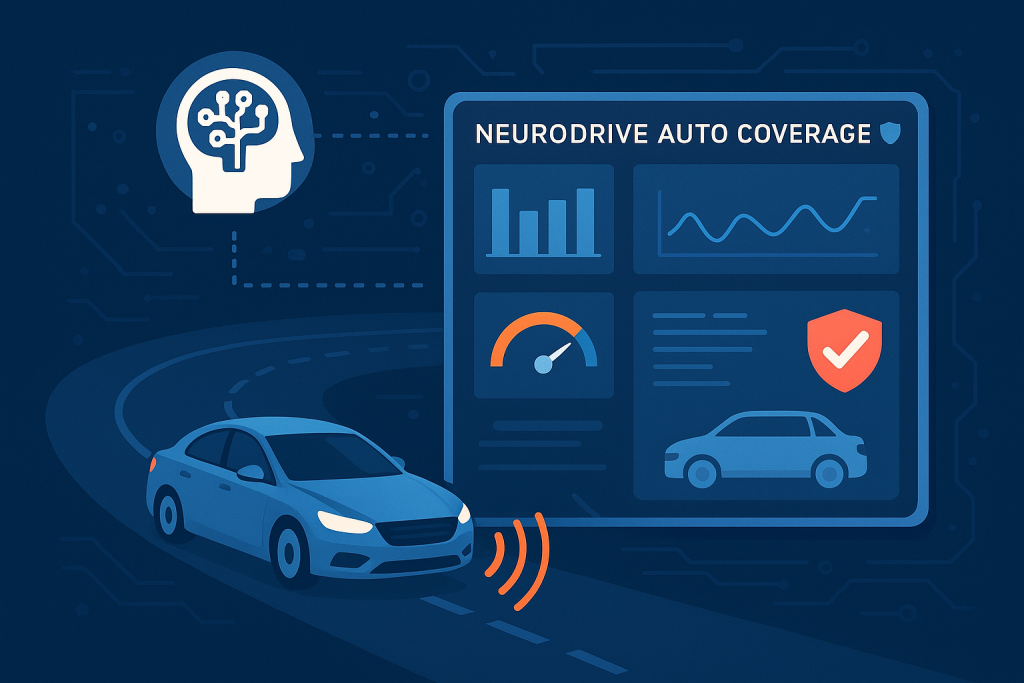
Table of Contents
ToggleThe Rise of AI in Auto Insurance
Car insurance is transforming, and NeuroDrive Auto Coverage USA is at the forefront. In 2025, AI car insurance USA 2025 isn’t just buzzwords – it’s reality. Artificial intelligence and machine learning are rapidly replacing old underwriting models. As Salesforce explains, AI-driven policies can evaluate actual driving behaviour, road conditions, and weather in seconds. This means policies are based on individual risk rather than age or ZIP code. Today’s tech can detect safe drivers with precision: for instance, telematics programs often reward good drivers with a discount. NeuroDrive leverages these innovations to create predictive driving insurance, forecasting risk using detailed data and dynamically adjusting coverage.
Key AI-driven trends in modern auto coverage include:
-
Telematics-based pricing – Usage-based insurance powered by vehicle data (like speed, braking, mileage). Safer drivers earn lower premiums.
-
Personalised premiums – AI analyses hundreds of data points (e.g., driving habits, location, weather) to tailor rates, making pricing fairer.
-
Claims automation – Digital claims processing using computer vision (photo analysis of damage), and AI speeds up settlements
-
24/7 virtual support – AI chatbots and virtual agents handle customer queries and even provide quotes instantly. Enhanced fraud detection – Machine learning flags suspicious claims early, reducing fraud and keeping costs low for honest drivers
These advances turn insurance from reactive protection into proactive risk management. According to Insurance Thought Leadership, AI and telematics together create “dynamic, behaviour-based pricing” and safer roads. NeuroDrive integrates these trends into a single platform. By using telematics car policy data and predictive driving insurance models, NeuroDrive continuously learns and evolves. The outcome is smarter auto coverage that rewards good drivers and addresses risks before accidents happen.
What is NeuroDrive Auto Coverage USA?
NeuroDrive Auto Coverage USA is a hypothetical yet plausible next-generation insurance platform designed for 2025. Think of it as an insurtech solution that combines neural network AI, advanced telematics, and big data to reimagine how policies are underwritten. The “Neuro” in its name suggests intelligence: NeuroDrive uses sophisticated algorithms (and possibly even neuroscience-inspired AI) to monitor driving. Key features of NeuroDrive include: NeuroDrive Auto Coverage USA.
-
Real-time Risk Assessment: NeuroDrive uses in-car sensors and smartphone apps to collect continuous driving data. Each trip is analysed for speed patterns, braking habits, and other behaviours. This data feeds a predictive model that assesses crash likelihood before a claim is even filed.
-
Personalised Pricing: Traditional premiums rely on broad demographics, but NeuroDrive’s pricing is individualised. For example, young safe drivers often pay less under AI-based models because their good habits are recognised.
-
Incentive Programs: Safe driving is rewarded. Users earn premium discounts and rewards for hitting safety targets. For instance, reducing daily accident risk by avoiding night driving or hard braking can lower annual rates.
-
Predictive Analytics: NeuroDrive employs predictive driving insurance models. By analysing historical and live data, it forecasts which drivers or roads are likely to see incidents. This lets insurers and drivers act ahead of accidents.
-
AI-Assisted Claims: If an accident occurs, NeuroDrive streamlines claims with AI. Drivers can upload photos; AI image analysis quickly assesses damage. In tandem, in-car data (e.g., from telematics) reconstructs the crash scenario for fast, fair settlements.
-
Behavioural Alerts: The system can coach drivers in real time. NeuroDrive might send alerts for risky habits (like tailgating or smartphone distraction), helping drivers correct course and avoid future claims.
By fusing these elements, NeuroDrive Auto Coverage USA 2025 is not a static policy – it’s an ongoing service. It effectively turns insurers into “prevention partners” instead of mere payers. NeuroDrive Auto Coverage USA
As one analysis notes, telematics and AI shift insurers’ focus toward preventing accidents. NeuroDrive embodies this shift, using data not just to ensure risk, but to help drivers become safer on the road.
Telematics Car Policy: Usage-Based Insurance Explained?
A telematics car policy (also known as usage-based insurance, UBI) is central to NeuroDrive’s model. Telematics refers to the technology that collects and transmits driving data via devices or apps. Examples include GPS trackers, OBD-II devices, or smartphone sensors. Here’s how it works:
-
Data Collection: A telematics device or mobile app records metrics like GPS location, speed, braking, acceleration, and mileage. Modern cars often come with built-in connectivity for this purpose. In fact, over 90% of recent U.S. cars already include telematics systems.
-
Analysis: The driving data is sent to the insurer’s analytics platform. Here, AI and algorithms assess patterns. Safe behaviours (smooth cornering, moderate speeds) are contrasted with risk markers (harsh braking, rapid acceleration, night driving).
-
Premium Adjustment: Insurers use this behaviour profile to set premiums. Under a telematics plan, good drivers pay less. Geotab explains: “Insurance telematics promotes fairer pricing and rewards safe driving habits by basing rates on actual driving behaviour rather than broad demographic factors. For example, if a driver never speeds and mostly drives during low-risk daytime hours, their rate can drop significantly.
-
Feedback Loop: Policyholders often see driving scores or receive coaching tips. NeuroDrive might push notifications like “Your last 10 trips were accident-free – keep it up for more discounts!” This gamified feedback encourages sustained safe driving.
Key benefits of telematics policies:
-
Lower Premiums for Safe Driving: Numerous studies show drivers save by sharing data. Many insurers offer discounts (up to 30% or more) to UBI participants.
-
Improved Safety: Real-time monitoring can trigger alerts – for instance, warning if a driver is approaching a known accident-prone area. Data shows fleets using telematics reduce crash rates through targeted coaching.
-
Efficient Claims: With detailed trip data, insurers can quickly reconstruct accidents. Ravin.ai notes that telematics data “makes the claims process faster, smoother, and easier for everyone.” Accurate speed/location logs help adjusters determine fault rapidly.
-
Fairness & Transparency: Drivers’ premiums reflect their actual risk. A safe young driver might pay far less with NeuroDrive’s telematics policy than under a traditional plan.
However, usage-based policies also raise privacy questions. NeuroDrive addresses this by ensuring explicit consent and strong data encryption. In future surveys, most drivers who try telematics accept it once they see lower rates and quick claim handling.
Predictive Driving Insurance: Data-Driven Risk Forecasting?
Predictive driving insurance is the concept of using big data and analytics to anticipate risk before it happens. NeuroDrive Auto Coverage USA harnesses predictive models in several ways:
-
Risk Mapping: By analysing aggregated driving data, NeuroDrive identifies high-risk zones (e.g., accident hotspots) and times (rush hour, severe weather). Insurers can then proactively advise drivers to avoid or be aware of these conditions.
-
Driver Scoring: Each driver gets a dynamic risk score. If data shows patterns linked to crashes (like frequent hard braking or late-night driving), the system flags them for coaching. For example, one model sees “frequent hard braking” as an early sign of unsafe driving, allowing intervention.
-
Pre-Claim Alerts: Suppose NeuroDrive predicts that a driver entering a storm-heavy area on the highway has an elevated risk. The app could send a safety reminder or even suggest delaying the trip. This kind of predictive coaching is unique to advanced systems.
-
Dynamic Policies: NeuroDrive might adjust coverage in near-real time. For instance, if a driver starts a long road trip (higher exposure), NeuroDrive could temporarily increase coverage or premium rate until the trip ends, all communicated instantly via mobile app.
Example: A NeuroDrive subscriber’s driving patterns (collected via smartphone app) show they rarely drive after 10 PM and maintain calm driving scores. The system predicts 20% lower accident probability for them. Accordingly, their premium is reduced to reflect this lower risk.
Predictive analytics in auto insurance has proven benefits. One industry analysis states that insurers using predictive models can “anticipate and mitigate risks before they manifest In Texas, insurers already use weather and traffic data to adjust policies and reserves. NeuroDrive applies similar intelligence nationwide.
Overall, predictive driving insurance turns raw data into preventive action. It shifts the insurer’s role from passive indemnifier to active safety partner. Policyholders gain: crashes are fewer, claims are smoother, and pricing is more equitable. NeuroDrive’s predictive engine is its core advantage – it’s what lets NeuroDrive offer “smarter policies for every driver” by truly understanding individual behaviour and environment.
Benefits of NeuroDrive Auto Coverage USA?
NeuroDrive’s innovative approach yields clear advantages for drivers and carriers alike. Key benefits include:
-
Personalised Premiums: As Salesforce notes, AI auto insurance creates “personalised pricing” based on behaviour. NeuroDrive embodies this, giving each driver a fair rate. For example, a commuter who drives carefully may pay far less than a high-risk driver of the same age and location.
-
Lower Premiums for Safe Drivers: With telematics and AI, NeuroDrive rewards safe habits directly. Reports show drivers with good records can save 15–25% or more. NeuroDrive’s incentives (discounts, cash-back, or gift cards) further sweeten the deal for cautious drivers.
-
Faster, Streamlined Claims: AI image analysis and telematics speed up claims settlement. After an accident, a user can upload accident photos; NeuroDrive’s system instantly assesses damage. Coupled with GPS logs, claims go through faster with less paperwork.
-
Improved Customer Experience: 24/7 AI chatbots and a slick mobile app make policy management a breeze. As one expert notes, AI-driven insurers can “provide instant quotes, reduce processing times and offer actionable insights Customers benefit from real-time updates (e.g., premium changes after a year of safe driving) and easy adjustments.
-
Enhanced Safety: Because NeuroDrive emphasises prevention, customers often become better drivers. Studies suggest that when individuals know their driving is monitored, they drive more carefully. Plus, NeuroDrive can coach drivers on-the-fly (e.g., “Slow down – harsh braking detected!”). The indirect effect is fewer accidents and safer roads, community-wide
-
Fairness and Inclusivity: NeuroDrive’s AI underwriting is less biased by demographics. For example, gender and credit score may play no role. Instead, a safe driver of any age or background can qualify for low rates. This opens affordable coverage to more people (like young drivers with good habits).
-
Fraud Prevention: With data transparency, fraudulent claims are harder to make. If a crash report doesn’t match the telematics logs (speed, time), AI can flag it. This reduces costs for insurers and honest customers.
Example Statistics: McKinsey predicts the telematics insurance market will grow over 25% annually through 2025, driven by demand for personalised coverage and safer roads. Insurance Thought Leadership also reports that despite less traffic, over 40% of fatal crashes happen at night, a risk factor that NeuroDrive can account for in real time. By proactively adjusting premiums and alerts for such conditions, NeuroDrive delivers both savings and safety.
Implementation and Challenges?
Rolling out AI-powered auto policies like NeuroDrive’s involves challenges, but these are manageable:
-
Data Privacy: Collecting driving data requires consent and security. NeuroDrive uses transparent opt-in agreements and robust encryption. Customers clearly see what is tracked (usually GPS, speed, braking). Public studies indicate that drivers accept telematics when they see concrete benefits (like discounts.
-
Technology Infrastructure: NeuroDrive relies on cloud analytics and AI. Insurers must invest in big data platforms and partner with telematics providers. Many carriers already collaborate with tech firms to avoid building everything in-house. For example, partnering with fleet telematics companies or AI startups.
-
Regulatory Compliance: Usage-based insurance is subject to regulations and state laws. NeuroDrive ensures compliance by anonymising data where required and adhering to insurance regulations. Clear privacy policies and audit trails help build trust with regulators and consumers.
-
User Engagement: The program’s success depends on driver participation. NeuroDrive incentivises engagement through user-friendly apps and rewards. The interface educates drivers on scores and tips, making the system intuitive rather than intrusive.
-
Actuarial Accuracy: Shifting from actuarial tables to AI models requires new risk assessment skills. NeuroDrive’s predictive algorithms are continually trained with new data. Over time, the system “learns” from outcomes to refine its models, addressing early mis-pricing.
-
Hardware Adoption: Although many cars have built-in telematics, others require add-ons. NeuroDrive offers plug-in OBD devices or smartphone-based monitoring, covering all vehicle types. As smartphone sensor tech improves, the entry barrier lowers (drivers need only an app).
By tackling these areas, insurers deploying NeuroDrive-like solutions can reap long-term gains. Early adopters gain competitive edges: a startup insurer branded around NeuroDrive could capture tech-savvy customers, while established carriers can use it to revitalise their image.
FAQs (Frequently Asked Questions)
Q1: What is NeuroDrive Auto Coverage USA?
A: NeuroDrive Auto Coverage USA is a concept for an AI-powered car insurance program in 2025. It uses telematics and predictive analytics to tailor premiums and policies to each driver’s habits. In essence, NeuroDrive offers smarter insurance policies by constantly analysing driving data to improve pricing and safety. This means if you drive safely, you pay less
Q2: How does AI car insurance (USA 2025) work?
A: AI car insurance in 2025 uses machine learning algorithms and real-time data. For example, an AI car insurance USA 2025 system like NeuroDrive collects driving data (speed, braking, location) via apps or devices.
It then calculates risk instantly to set premiums and detect fraud. The result is dynamic pricing – your rate can go down for safe driving or adjust for high-risk situations on the fly.
Q3: What is predictive driving insurance?
A: Predictive driving insurance means using big data to forecast driving risks. Instead of only reacting after accidents, the insurer uses data science to anticipate crashes before they happen.
NeuroDrive exemplifies this: it might spot that driving 80 mph on wet roads at night increases your risk and adjust your policy accordingly. This foresight allows insurers to encourage safer driving proactively.
Q4: How does a telematics car policy save me money?
A: In a telematics car policy, your actual driving behaviour determines your premium. If you typically drive carefully (obey speed limits, avoid harsh braking), the insurer rewards you with discounts.
Geotab explains that telematics “rewards safe driving habits by basing rates on actual driving behaviour”. Many policyholders see significant savings compared to standard rates because they demonstrate lower risk on the road.
Q5: Are there privacy concerns with NeuroDrive?
A: Privacy is important. NeuroDrive (and similar telematics programs) only tracks driving-related data with your consent. It doesn’t record private conversations or personal app usage.
All collected data is encrypted, and you can opt in or out. Most drivers find the trade-off acceptable once they see lower premiums and faster claim service. According to industry insights, transparent data policies build customer trust even when detailed vehicle data is collected. ed
Q6: How can I get a discount with NeuroDrive Auto Coverage?
A: To earn discounts with NeuroDrive, simply drive well! That means obey speed limits, avoid hard stops, and stay off the road during dangerous conditions when possible.
NeuroDrive’s app might show you a driving score or tips. For instance, consistently maintaining a high safety score for 6 months could unlock a 20% premium reduction. The exact incentives depend on the insurer offering NeuroDrive coverage, but safe habits always translate to savings.
Q7: What role does AI play in NeuroDrive’s claims process?
A: AI greatly speeds up claims. If you file a claim with NeuroDrive, you might just upload photos of the damage. The AI quickly assesses severity and cost.
Meanwhile, your telematics data (e.g., exact location and speed at the time of the incident) helps verify the report. This means faster payouts for you and less admin for the insurer. AI can even detect if the damage shown is new or pre-existing, reducing fraud.
Conclusion
NeuroDrive Auto Coverage USA 2025 represents the next wave of AI car insurance USA 2025 – one where data, telematics, and predictive analytics converge to empower drivers. By using cutting-edge predictive driving insurance models, NeuroDrive creates personalised, fairer policies for every driver. Safe drivers benefit from significant discounts, while insurers gain efficiency and fraud control. Ultimately, smarter policies for every driver mean safer roads and better coverage for all.
As we’ve seen, the future is here: companies are already using AI to match premiums to real behaviour, and telematics is proving its worth in market growth. NeuroDrive Auto Coverage USA embodies these trends. If you’re a driver curious about AI-driven insurance, ask your agent if they offer usage-based or predictive policies. And if you liked this overview, share it on social media or let us know your thoughts below. The road ahead in auto insurance is bright – and NeuroDrive is leading the way.
